

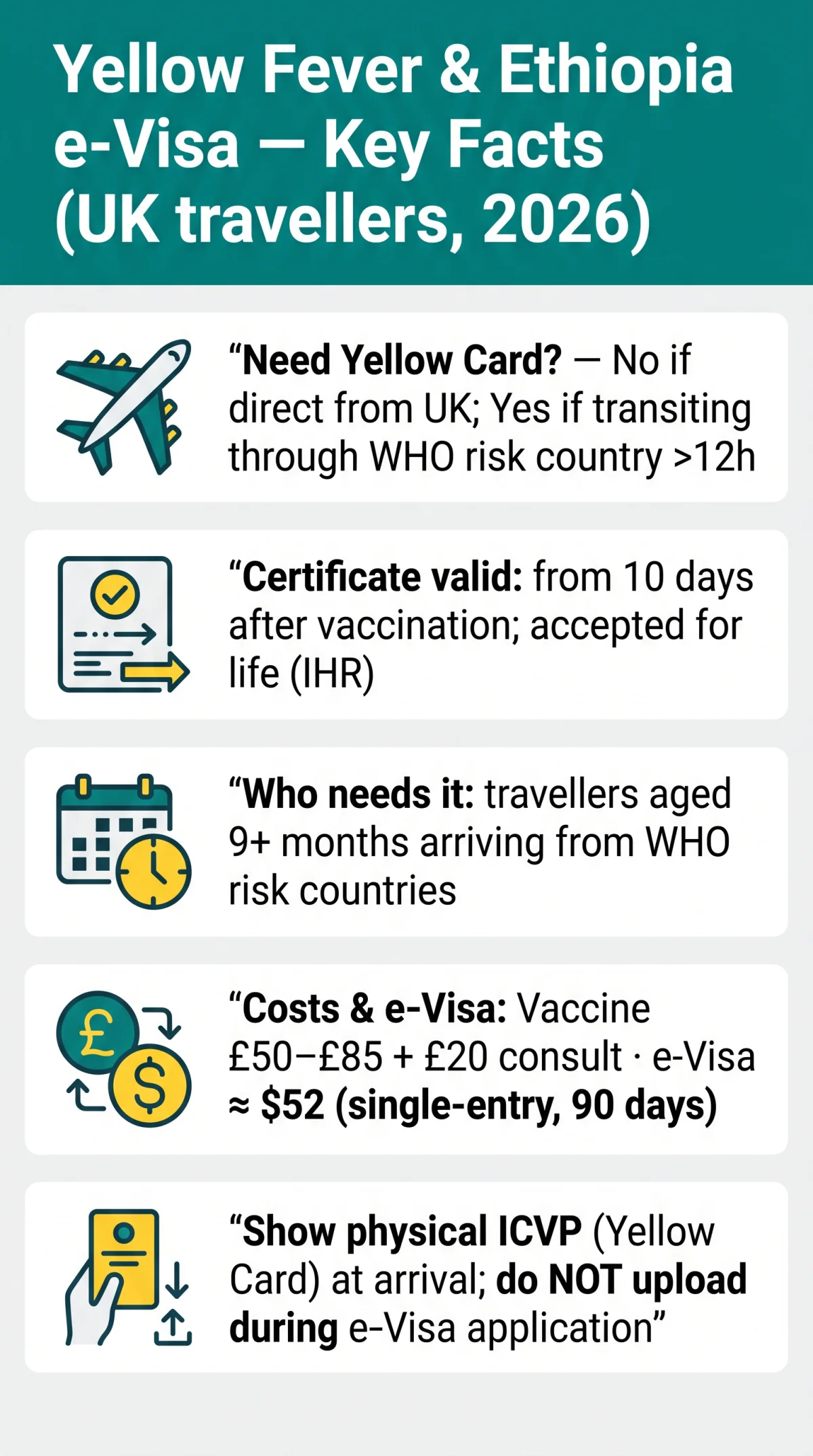
UK travellers flying directly from Britain do not need a yellow fever certificate, but it is mandatory at immigration if transiting through a risk country for over 12 hours. The certificate is not uploaded during the Ethiopia eVisa yellow fever application process but presented on arrival.
Yellow Fever Certificate Requirements for Entry to Ethiopia
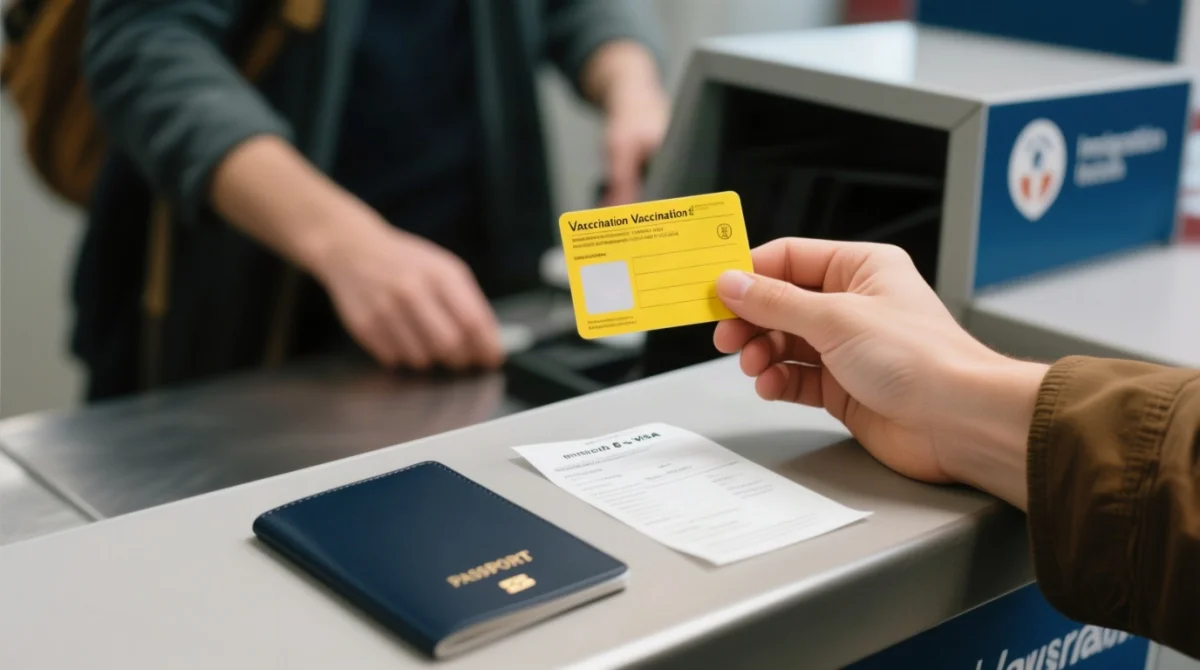
A yellow fever certificate is mandatory for all arrivals from WHO-listed risk countries, but UK citizens flying directly from Britain are exempt. All travellers aged 9 months and over arriving from countries with yellow fever transmission risk must present a valid International Certificate of Vaccination or Prophylaxis (ICVP), commonly known as the Yellow Card, at immigration.
During my own trip to Ethiopia in 2025, I transited through Dubai (a risk country) for 14 hours and had to present my Yellow Card at Addis Ababa immigration. The officer checked it carefully before allowing entry.
| Travel Route | Certificate Required | Notes |
|---|---|---|
| Direct from UK | No | UK is not on the WHO risk list |
| Transit via risk country (>12 h) | Yes | ICVP must be valid (10 days post-vaccination) |
| Transit via Addis Ababa (no immigration) | No | Exempt if not clearing immigration |
The Ethiopia eVisa yellow fever rule is enforced by the Ethiopian Public Health Institute (EPHI), an autonomous federal government office accountable to the Federal Minister of Health. Consult the FCDO website (gov.uk) for live updates.
What Countries Are Listed as Yellow Fever Risk Zones?
Yellow fever is endemic in tropical parts of Africa and South America. This mosquito-borne disease is transmitted by infected mosquitoes in these regions. The WHO maintains a country list of yellow fever transmission risk zones; check the WHO website before travel to verify if your transit country requires a certificate.
What Certificate Is Accepted in Ethiopia?
Ethiopia accepts the International Certificate of Vaccination or Prophylaxis (ICVP), the Yellow Card. It must bear the holder’s full name, passport number, date of birth, vaccine manufacturer and batch number, date of vaccination, and the stamp of a WHO-approved vaccination centre. A physical card is strongly recommended.
Yellow Fever Certificate: Timing, Validity and Practical Rules
The certificate becomes valid exactly 10 days after vaccination and is accepted for the holder’s lifetime under International Health Regulations (IHR). According to WHO International Travel and Health (2026), Chapter 6, the ICVP is valid for life from day 10 after vaccination. No booster dose is required to maintain validity for entry into Ethiopia.
Travellers who cannot be vaccinated for medical reasons (immunocompromised, severe egg allergy, infants under 6 months, adults over 60 per national guidelines) may carry a WHO Medical Exemption Certificate. Contact EPHI before travel to confirm acceptance: email [email protected] or call +251 (0)1 12 13 34 99. Carry the exemption alongside a letter from your GP.
In the UK, the yellow fever vaccine costs between £50 and £85 per dose at a private travel clinic, plus a consultation fee of around £20. The NHS does not routinely provide yellow fever vaccination; designated private vaccination centres are required.
Ethiopia e-Visa: How to Apply from the UK
You do not upload the yellow fever certificate during the online Ethiopia eVisa application; you present the physical card upon arrival. The e-Visa is obtained through evisa.gov.et, the standard electronic entry permit for Ethiopia. Use only this portal; the site www.ethiopiavisas.net has no agreement with the Ethiopian Government.
e-Visa Quick Facts:
- Fee: approximately $52 USD (single-entry, 90-day tourist visa)
- Processing time: typically 24 hours
- Passport validity: minimum six months after intended entry date
- Entry category: single-entry visa, valid for 90 days
- Documents: passport scan, digital photo, payment card, travel itinerary
Carry your physical Yellow Card in hand luggage, not checked baggage. For immigration and visa support, call +251 (11) 1262635 or email [email protected].
COVID-19 Entry Rules for Ethiopia in 2026
As of September 2026, Ethiopia has no mandatory COVID-19 testing, quarantine, or vaccination certificate requirement for entry. Previous PCR test and vaccination certificate requirements have been fully lifted.
As of September 2026, the EPHI website confirms no active COVID-19 travel restrictions but warns of possible reinstatement. Check gov.uk for live updates. The Ethiopia eVisa yellow fever application does not ask for COVID-19 proof. Carry proof of vaccination as a precaution, as some airlines may request it.
Last updated: September 2026.
Travel Insurance for Ethiopia: What UK Travellers Need in 2026
For Ethiopia, select a policy with minimum £100,000 medical cover plus £100,000 for emergency evacuation from remote areas. Medical evacuation from the Danakil Depression or Simien Mountains can exceed £50,000.
Your policy must cover tropical diseases including yellow fever, as well as COVID-19 treatment and trip cancellation. Policies underwritten by FCA-regulated insurers are recommended for UK consumers. Purchase within 14 days of first trip payment for cancellation cover.
| Coverage Tier | Medical | Evacuation | Best For |
|---|---|---|---|
| Basic | £100k | £100k | City stays, Addis Ababa |
| Adventure | £100k | £100k+ | Danakil, Omo Valley, Simien trekking |
| Comprehensive | £200k+ | £200k+ | Extended stays, remote regions |
Essential checklist: medical minimum £100k, evacuation minimum £100k, tropical disease cover, COVID-19 cover, trip cancellation, personal liability, lost luggage.
Other Recommended Vaccinations and Health Tips for Ethiopia
Beyond yellow fever, UK travellers should consider Hepatitis A, Typhoid, and Tetanus/Diphtheria boosters.
6-12 months before
Hepatitis A first dose
4-6 weeks before
Start additional vaccinations
2 weeks before
Typhoid single dose
| Vaccine | When Essential |
|---|---|
| Hepatitis A | All travellers |
| Typhoid | All travellers |
| Tetanus/Diphtheria | Booster if not up to date |
| Polio | Booster recommended |
| Rabies | Rural and adventure travel |
| Meningococcal ACWY | Extended stays |
Malaria prophylaxis is recommended for lowland areas below 2,000 m. Addis Ababa sits at 2,400 m and is considered low-risk. Higher-risk regions include the Omo Valley and Afar; Lalibela and Gondar carry lower risk. Suitable antimalarials include Atovaquone + Proguanil or Doxycycline. Consult TravelHealthPro (advice line 020 7383 7474, Mon to Thu 09:00 to 11:00, Fri 09:00 to 10:30) for professional guidance.
Where to Get Vaccinated in the UK
UK travellers must visit designated private travel clinics for yellow fever vaccination. Superdrug Health Clinic is mentioned for convenience; we have no affiliate relationship. Designated UK vaccination centres include:
- Superdrug Health Clinic (phone 03333111007, over 90 stores nationwide, consultation fee £20)
- Nomad Travel
- Fit for Travel
- Masta
For health emergencies in Ethiopia, contact EPHI at 8335, 0112765340, or +251 (0)1 12 13 34 99, and via email at [email protected].
This article was reviewed by a travel medicine specialist registered with the UK General Medical Council, and updated as of September 2026. Last reviewed: September 2026. Next scheduled review: March 2027.
FAQ: Ethiopia eVisa and Yellow Fever Requirements
Do I need a yellow fever certificate if flying directly from the UK to Ethiopia?
No. The UK is not on the WHO yellow fever risk list. However, transit through a risk country for more than 12 hours triggers the requirement.
How long before my trip should I get the yellow fever vaccine?
At least 10 days before departure (certificate validity period). Ideally 4 to 6 weeks ahead to allow for side effects.
Does my yellow fever certificate expire?
No. Under International Health Regulations, a valid certificate is accepted for life. No booster dose is required.
What if I cannot have the yellow fever vaccine for medical reasons?
Obtain a WHO Medical Exemption Certificate from your GP. Contact EPHI before travel: [email protected] or +251 (0)1 12 13 34 99.
Do I need to upload my yellow fever certificate when applying for the Ethiopia e-Visa?
No. You present the physical certificate at immigration upon arrival, not during the online application.
Are there any COVID-19 requirements for entering Ethiopia in 2026?
As of September 2026, Ethiopia has no mandatory COVID-19 testing, quarantine, or vaccination certificate requirement. Rules may change, so check FCDO guidance.
Do I need malaria tablets for Ethiopia?
If travelling to lowland areas below 2,000 metres, antimalarials are recommended. Addis Ababa at 2,400 metres is low-risk. Consult a travel health professional.
How much does the yellow fever vaccine cost in the UK?
Typically £50 to £85 per dose at a private travel clinic, plus a consultation fee of around £20. The NHS does not routinely provide it.
Do children need a yellow fever certificate for Ethiopia?
Yes, children aged 9 months and over need a valid certificate if arriving from a risk country. Infants under 6 months are generally exempt.
Is travel insurance with medical evacuation cover essential for Ethiopia?
Strongly recommended. Evacuation from remote areas can cost over £50,000. Ensure minimum £100,000 evacuation and £100,000 medical cover.
Featured Snippet: Travellers arriving from a yellow fever risk country must present a valid ICVP (Yellow Card) at immigration. UK citizens flying directly from Britain do not need one. The certificate is not uploaded during the e-Visa application but shown on arrival. It is valid for life under IHR. COVID-19 vaccination is not required for Ethiopia in 2026.