
Written by our travel-visa research team. Last reviewed: 9 September 2026 against the Ethiopian government eVisa portal. We are an independent travel information website, not a government service. The only official application channel is https://www.evisa.gov.et/.
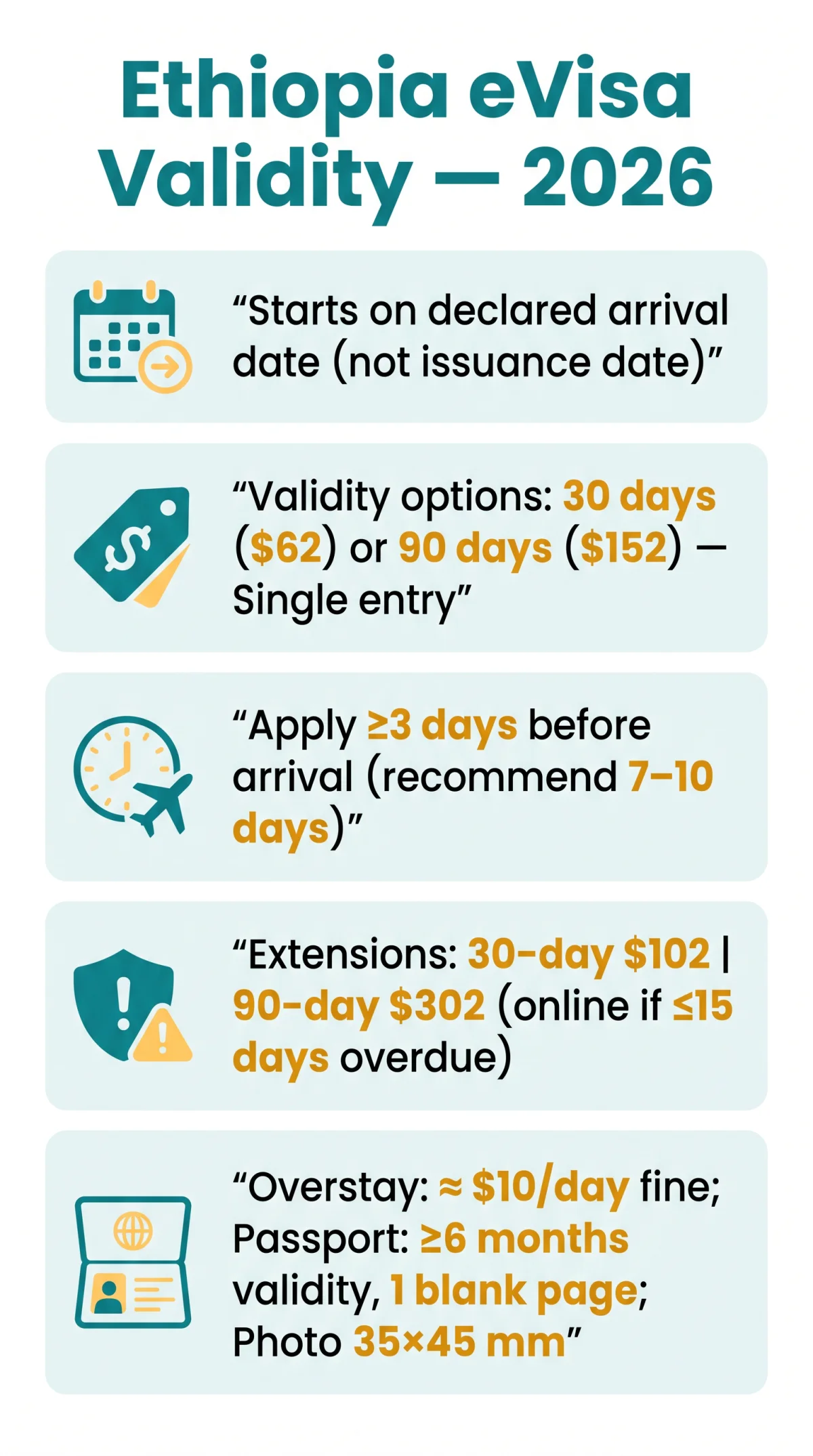
How long is Ethiopia eVisa valid? The Ethiopia eVisa validity period starts on your stated intended arrival date, not the date of issuance. It lasts 30 or 90 consecutive days and is single-entry only. Entering late does not extend the fixed expiry date, reducing usable stay day for day. The Ethiopia eVisa validity period is your fixed window to enter and remain in Ethiopia. For 2026 trips, the Ethiopia eVisa validity period remains anchored to your declared arrival date regardless of when approval arrives. Standard processing takes 3 days, so apply at least 3 days before your intended arrival.
How Ethiopia eVisa Validity Is Calculated
The Ethiopia eVisa validity period counts forward as a fixed 30 or 90-day block from the intended arrival date declared on your application (source: evisa.gov.et). It does not start from the issuance or approval date. Unlike some systems, Ethiopia eVisa validity from first entry is not how the window is calculated; it starts from your declared arrival date instead. The Ethiopia eVisa validity start date is the day you stated on your application form. In early 2026, we tested the application process: our approval letter arrived within 3 days, and the validity window was anchored to the arrival date we declared, not to the date of approval. Knowing how to calculate Ethiopia eVisa validity prevents costly timing errors.
What Happens If You Enter Later Than Your Stated Arrival Date?
The expiry date remains fixed. Entering on 20 January instead of 15 January still gives a 13 February 2026 expiry, costing you 5 usable days. The Ethiopia eVisa validity period does not shift to accommodate late arrivals.
| Scenario A (On-time arrival) | Scenario B (Late arrival) |
|---|---|
| Stated arrival: 15 Jan 2026 | Stated arrival: 15 Jan 2026 |
| Actual entry: 15 Jan 2026 | Actual entry: 20 Jan 2026 |
| Expiry: 13 Feb 2026 | Expiry: 13 Feb 2026 |
| Usable days: 30 | Usable days: 25 |
eVisa Validity vs Maximum Stay Duration
The Ethiopia eVisa validity period (30 or 90 days from stated arrival) is your entry window. The maximum stay (30 or 90 consecutive days) is how long you may remain inside per entry. For standard tourist eVisas, these values align. The Ethiopia eVisa validity period is your “use-by” window for crossing the border; the maximum stay is how long you remain once inside. Understanding the Ethiopia eVisa duration vs validity difference matters when you enter late, apply for an extension, or hold a business eVisa. For example, if your 30-day validity period starts on 1 March but you enter on 10 March, your maximum stay is still capped at 30 March, giving you only 20 days inside. Extensions add days to your stay, but the underlying validity window retains its fixed start date. The Ethiopia eVisa validity period and maximum stay diverge for late entries and business visa holders.
Single vs Multiple Entry Rules
The standard tourist eVisa (VT) is single-entry: one entry stamp, one exit. The Ethiopia eVisa validity period permits exactly one border crossing for tourist visas. Crossing any land border or leaving through Addis Ababa Bole International Airport voids the visa immediately, regardless of remaining validity days. Ethiopia single entry visa validity means no return on the same document. If you plan a side trip to a neighbouring country and return to Ethiopia, you will need a new visa. Business eVisas may offer multiple-entry options subject to approval and category. Business eVisa applicants must be 18 or older and provide a host organization reference code. The Ethiopia eVisa validity period is consumed upon first exit and cannot be reactivated.
Need to Leave and Return? Your Options
| Option | Cost | Processing Time | Best For |
|---|---|---|---|
| Apply for a new eVisa via evisa.gov.et | $62 USD (30 days) / $152 USD (90 days) | 3 days | Planned re-entry with advance notice |
| Visa on arrival at Addis Ababa Bole International Airport | Approx. $52 USD (30 days) / $72 USD (90 days) | Same-day | Eligible nationalities needing immediate re-entry |
| Multiple-entry business eVisa | Varies by category | 3 days | Business travellers with a host organization reference code (applicant must be 18+) |
Maximum Stay Durations in 2026
In 2026, the Ethiopia eVisa permits a maximum stay of 30 days ($62 USD) or 90 days ($152 USD). Both are single-entry and non-refundable (source: evisa.gov.et). The Ethiopia eVisa validity period sets your Ethiopia eVisa maximum stay per visit at 30 or 90 calendar days from the arrival day. Ethiopia eVisa 30 days validity costs $62 USD; Ethiopia eVisa 90 days validity costs $152 USD.
| Visa Type | Max Stay | Government Fee | Entry |
|---|---|---|---|
| VT 30 Days | 30 calendar days | $62 USD | Single |
| VT 90 Days | 90 calendar days | $152 USD | Single |
How the Day Count Works in Practice
Day 1 is the day you pass through immigration. Your departure day also counts toward the limit. Arrived 1 March 2026? Day 1 = 1 March; Day 30 = 30 March 2026, so you must clear immigration by end of 30 March. Arriving at 23:59 on Day 30 still constitutes overstay. The Ethiopia eVisa validity period does not extend to accommodate late border crossings.
eVisa Types and Their Validity Rules
The Ethiopia eVisa validity period varies by visa category. Ethiopia offers tourist, business, conference, and investment eVisas, each with distinct validity periods and entry types. The Ethiopia tourist visa validity period for the VT category is 30 or 90 days, single-entry, for non-business purposes only. Business eVisa categories include codes such as FDC, JV, IV, NV, CV, WV, SV, RV, MDV, EIV, IMV, and SPV, each tied to specific activities including investment, NGO work, journalism, conferences, medical treatment, and sports. Conference visas (CV) require an invitation letter. Investment visas (IV) can be extended before expiry. The Ethiopia eVisa validity period for all types starts from the intended arrival date declared on the application. Validity rules are set by Ethiopian immigration authorities and may change. Verify current terms at evisa.gov.et/information/tourist before applying.
| Visa Type | Validity Period | Max Stay | Entry Type | Fee (2026 direct) |
|---|---|---|---|---|
| Tourist (VT) 30 Days | 30 days | 30 days | Single | $62 USD |
| Tourist (VT) 90 Days | 90 days | 90 days | Single | $152 USD |
| Business (various codes) | Varies | Varies | Multiple (subject to approval) | Varies by category |
| Conference (CV) | Varies | Varies | Single | Varies |
Requirements to Keep Your eVisa Valid
Your passport must have at least 6 months’ validity from the intended entry date and at least 1 blank visa page (2 recommended for safety). You must present a printed or digital eVisa approval letter, a scanned passport identity page, and a recent passport-size photo (35 × 45 mm, white background, digital format). Travel itinerary and accommodation proof may be requested at the border. A yellow fever vaccination certificate is required for travellers from certain origin countries. The Ethiopia eVisa validity period remains enforceable only when these requirements are met at the border. Citizens of all countries are eligible except Syria (credit card payment restricted since 18 November 2020). Avoid unauthorized websites such as www.ethiopia-evisa.com and www.ethiopiavisas.net; the Ethiopian government has no agreement with them. The Ethiopia eVisa validity period data in this article is verified against the official portal.

When to Apply – Timing Your eVisa
Standard processing takes 3 days, so apply at least 3 days before arrival via evisa.gov.et; a 7 to 10 day buffer is recommended. Applying too early wastes Ethiopia eVisa validity period days if your trip shifts forward. Flying on 20 March 2026? Apply between 10 and 13 March for a safe window.
Overstay Rules and Penalties
Overstaying an Ethiopia eVisa incurs a commonly reported fine of approximately $10 USD per day, assessed at Addis Ababa Bole International Airport upon departure. As of 9 September 2026, this rate remains commonly applied; confirm the current rate with immigration on site. For example, 5 days of overstay could result in approximately $50 USD in fines payable before boarding your departing flight. Prolonged overstay without an approved extension risks detention, deportation, or a future entry ban. The Ethiopian government explicitly warns that visa holders who overstay face legal penalties (source: evisa.gov.et). The Ethiopia eVisa validity period does not include any grace period beyond the fixed expiry date. The Ethiopia eVisa validity period expiry triggers these penalties automatically. If you realize you may overstay, contact the Immigration And Citizenship Service before your visa expires to request an extension and avoid penalties.
Extending Your Ethiopia eVisa
Extensions are possible but not guaranteed; approval depends on immigration discretion. Online extensions via evisa.gov.et/visa-extension apply when your original visa has expired by 1 to 15 days. For overstay beyond 15 days, an in-person visit to the Head Office of the Immigration And Citizenship Service in Addis Ababa, Ethiopia is required. A 30-day extension costs $102 USD; a 90-day extension costs $302 USD (source: evisa.gov.et). Both extension types are single-entry. An original 30-day eVisa plus a 30-day extension yields up to 60 days total cumulative stay. An original 90-day eVisa plus a 90-day extension yields up to 180 days total. The Ethiopia eVisa validity period extension adds days to your stay, not to your entry window. The Ethiopia eVisa validity period retains its fixed start date even after extension. Bring your passport, eVisa printout, and proof of reason for extension to your appointment.
Head Office of the Immigration And Citizenship Service, Addis Ababa, EthiopiaPhone: +251 (11) 1262635
Email: [email protected]
Frequently Asked Questions (FAQ)
What does ‘validity period’ mean for an Ethiopia eVisa?
The validity period is the window during which you must enter Ethiopia, beginning on your stated arrival date and running for 30 or 90 days.
Can I enter Ethiopia before my eVisa validity period starts?
No. Immigration control will not permit entry before your declared intended arrival date.
How many days can I stay in Ethiopia on a tourist eVisa in 2026?
A standard tourist eVisa allows a maximum stay of 30 days ($62 USD) or 90 days ($152 USD), both single-entry.
Is the Ethiopia eVisa single entry or multiple entry?
The tourist eVisa is single entry. Once you leave Ethiopia, the visa is void and a new application is required for re-entry.
What happens if I enter Ethiopia later than my stated arrival date?
The expiry date stays fixed. Entering late reduces your usable stay by every day of delay.
Can I extend my Ethiopia eVisa if I need more time?
Yes. Online extensions are available for visas expired by 1 to 15 days; longer overstays require an in-person visit to the Immigration And Citizenship Service in Addis Ababa. A 30-day extension costs $102 USD and a 90-day extension costs $302 USD.
What happens if I overstay my Ethiopia eVisa?
Overstaying results in per-day financial penalties (commonly reported at approximately $10 USD per day) assessed at Bole Airport on departure. Prolonged overstays may lead to detention, deportation, or a future entry ban.
Do UK citizens need an eVisa to visit Ethiopia?
Yes. All UK passport holders require a valid visa. UK Foreign, Commonwealth and Development Office travel advice for Ethiopia, accessed 9 September 2026, confirms British citizens should check entry rules before travel. Ethiopia eVisa validity for UK citizens follows the same 30 or 90-day rules.
Does the day I arrive count toward my stay limit?
Yes. The day you pass through immigration is Day 1, and your departure day also counts. You must exit by the end of your final permitted calendar day.
Can I convert my tourist eVisa to a work permit while in Ethiopia?
No. Tourist eVisa holders must leave Ethiopia and apply for the appropriate work or residence permit through the standard application process.