Published: 9 September 2026 | Last reviewed: 1 September 2026 | Next scheduled review: 1 December 2026
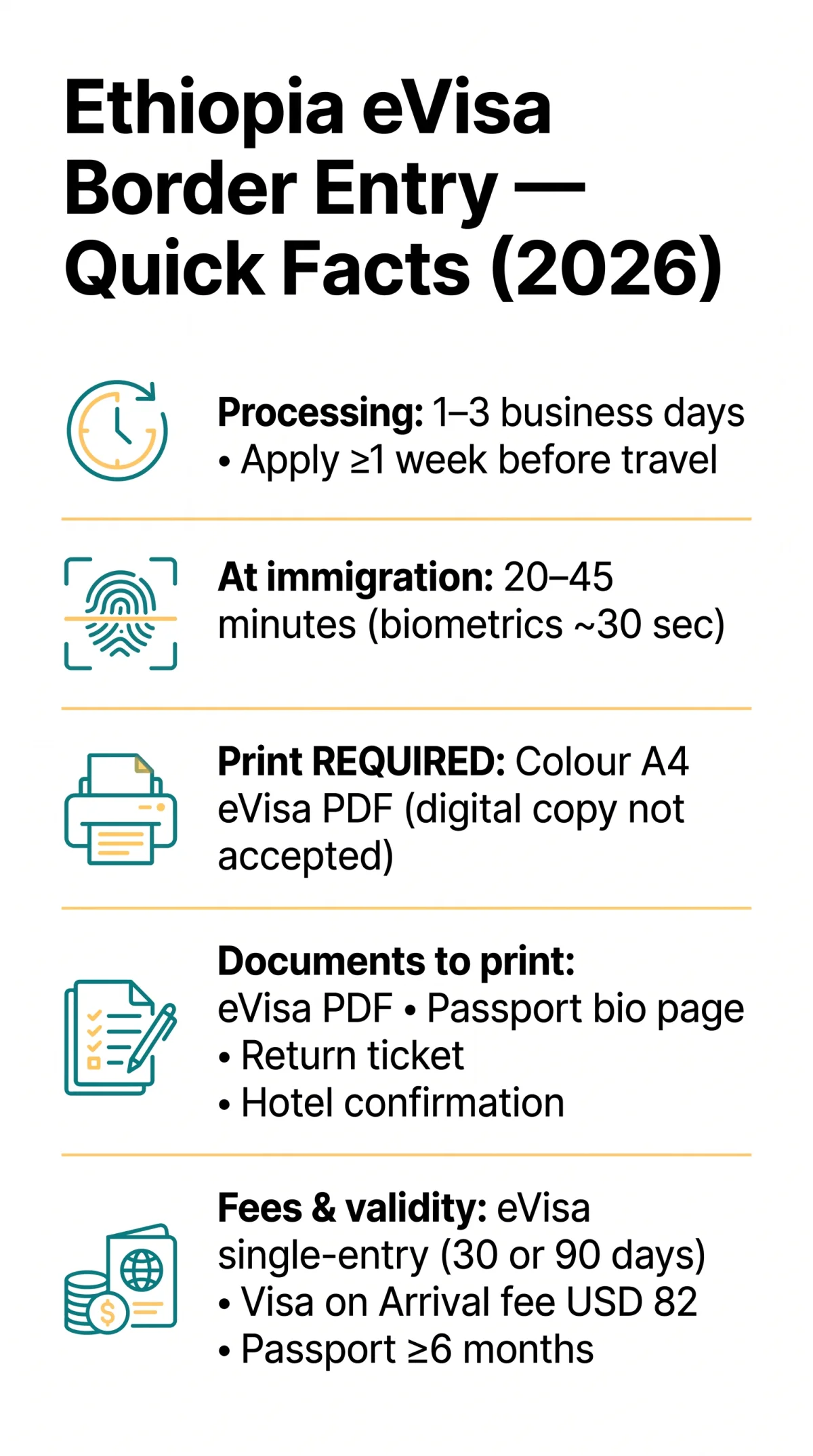
The Ethiopia eVisa border entry process at Addis Ababa Bole International Airport (ADD) takes 20 to 45 minutes and requires a printed eVisa approval PDF, a valid passport, and biometric capture. eVisa holders use a dedicated immigration lane separate from Visa on Arrival passengers.
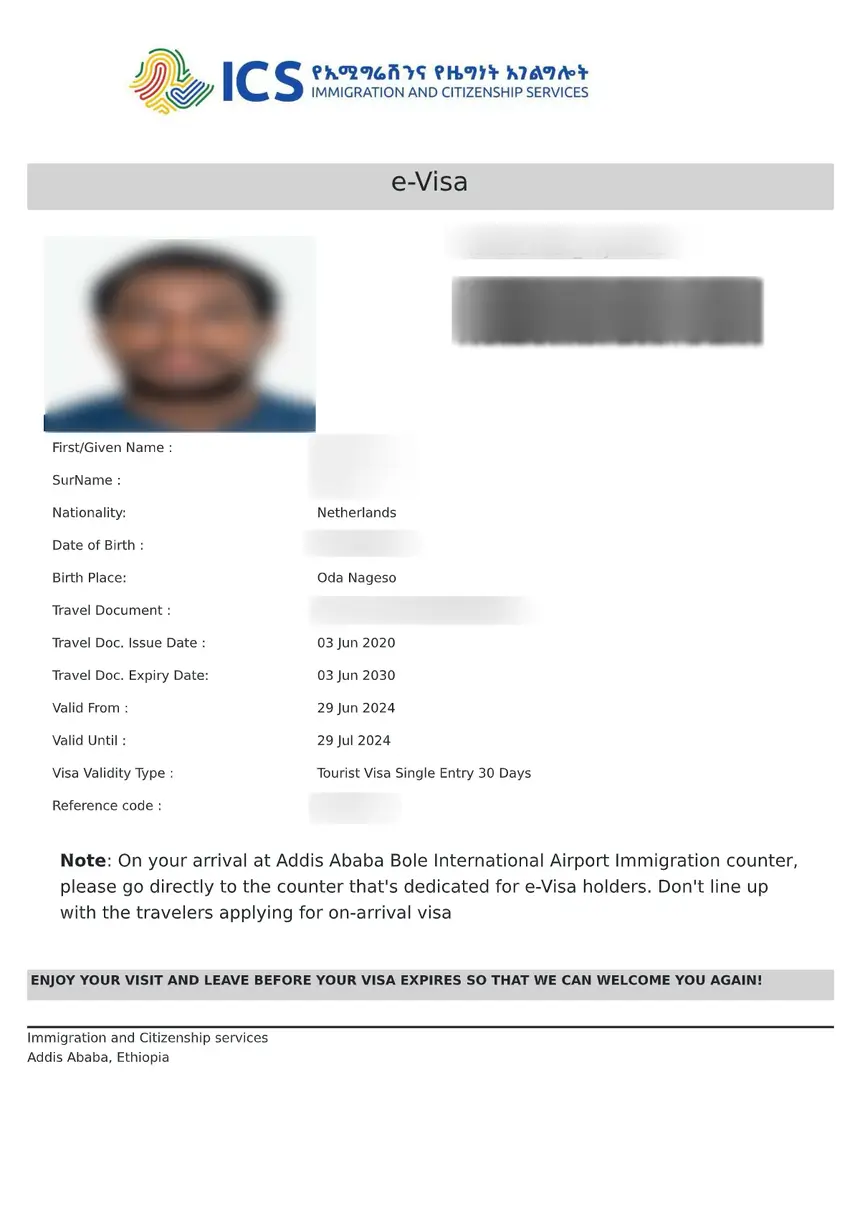
You must print a colour paper copy of your downloaded PDF because the Immigration and Citizenship Service (ICS) requires a physical document for stamping and archival. A phone screenshot or digital copy is not reliably accepted at the immigration counter.
Immigration officers will ask your purpose (tourism/business/transit), number of days you plan to stay, and your hotel name and address. After the interview, officers collect biometric data, including a right-index-fingerprint scan and a facial photograph, before issuing your entry stamp.
What Is the Ethiopian eVisa and Where to Apply Safely
The Ethiopia eVisa border entry process begins with obtaining a single-entry tourist visa (30 or 90 days) at the official website evisa.gov.et. The portal is operated by Ethiopian Airlines under the authority of the Immigration and Citizenship Service (ICS), based in Addis Ababa, with copyright period 2017 to 2026. Unlike Visa on Arrival, the eVisa is obtained before travel. Processing takes 1 to 3 business days; apply at least 1 week before travel. Payment is via Visa or Mastercard. Your passport must hold 6 months validity from the intended date of entry. The eVisa is eligible for extension on reasonable grounds. Business visa urgent service requires reason or evidence.
Avoid the fraudulent site www.ethiopiavisas.net. The Ethiopian Government has no agreement with its owners and is not responsible for payments made there. For Ethiopia eVisa border entry, use only evisa.gov.et. For support, call +251 (11) 1262635 or email [email protected].
Ethiopia eVisa Border Entry Checklist – What to Print Before Your Flight
Ethiopia eVisa border entry requires printed colour copies of the eVisa approval PDF, passport bio page, return flight itinerary, and hotel confirmation. Ensure passport validity of 6 months from the intended date of entry. Official entry requirements are published at evisa.gov.et, verified September 2026.
| Document | Why You Need It | Status |
|---|---|---|
| eVisa PDF (colour A4 printout) | ICS stamps and archives the physical copy; digital copy not reliably accepted | Required |
| Passport bio page copy | Supports identity verification alongside the original passport | Recommended |
| Return flight itinerary | Immigration confirms onward travel | Required |
| Hotel confirmation | Officers ask for your accommodation address | Required |
| Yellow Fever certificate | Required only if transiting through an endemic country; not needed on direct UK flights | Conditional |
| Travel insurance certificate | Practical safety net; not checked at immigration | Recommended |
These documents ensure smooth Ethiopia eVisa border entry at Bole Airport.
Step-by-Step Ethiopia eVisa Border Entry at Bole International Airport
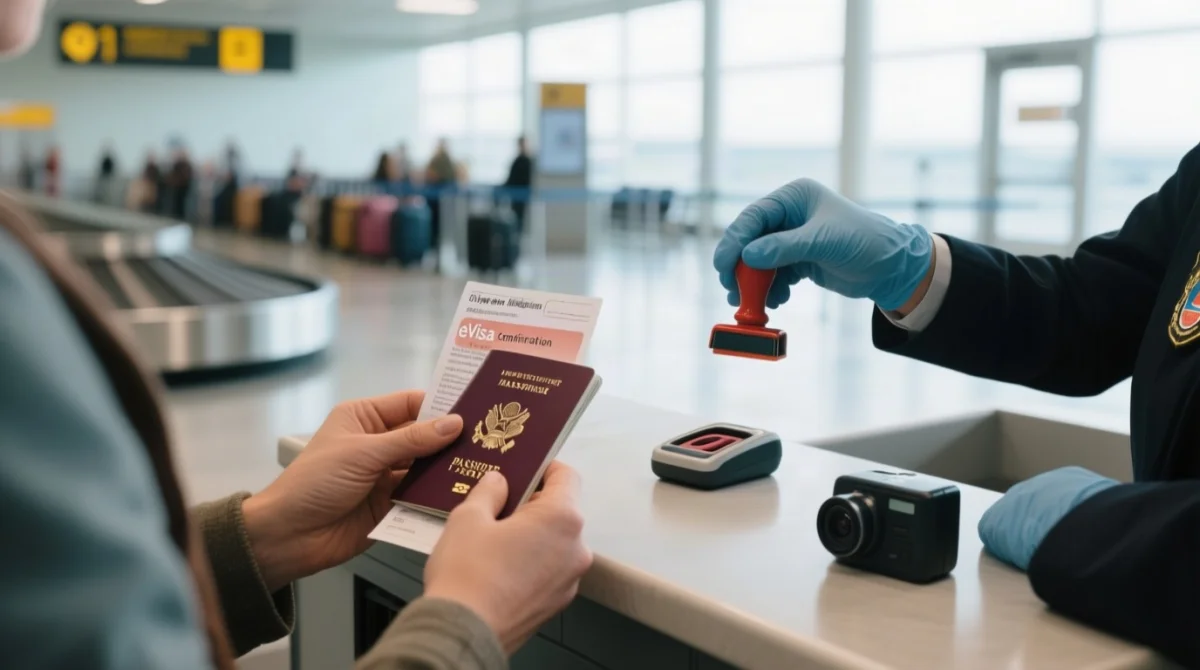
Ethiopia eVisa border entry at Bole Airport follows 8 steps: disembark, join eVisa lane, present documents, answer questions, provide fingerprints, receive stamp, collect baggage, clear customs.
Disembark at Terminal 2
Follow the “Arrivals” signage to the immigration hall.
Join the dedicated lane
Look for the lane marked “VISA / eVISA”, separate from Visa on Arrival and diplomatic lanes.
Present your printed eVisa PDF and passport
Hand them to the immigration officer. Officers speak English.
Answer standard questions
Be ready to answer about purpose, duration, accommodation, and return ticket.
Undergo biometric capture
Right-index-fingerprint scan and facial photograph taking approximately 30 seconds.
Receive an entry stamp
Verify the stamp containing the date of entry, visa type, and permitted duration of stay before leaving the counter.
Proceed to baggage claim
Collect your checked luggage.
Clear customs
Checked luggage undergoes X-ray screening before the terminal exit.
When entering Ethiopia with an eVisa at this border crossing, proceed to the immigration hall at Bole International Airport, join the eVisa lane, present your printed eVisa confirmation and passport, answer standard questions about your stay, provide fingerprints and a photo, and receive your entry stamp.
Common mistakes during the Ethiopia eVisa border entry process at this port of entry include joining the wrong queue, arriving without a printed eVisa, and leaving the counter without checking the entry stamp.
Ethiopia eVisa Border Entry Interview – Immigration Questions and Answers
The Ethiopia eVisa border entry interview covers visit purpose, stay duration, accommodation, return ticket, and occupation, all conducted in English.
Have printed documents ready for Ethiopia eVisa border entry and keep answers concise:
- “What is the purpose of your visit?” “Tourism.”
- “How long will you stay?” “X days, as shown on my eVisa.”
- “Where are you staying?” Provide hotel name and address.
- “Do you have a return ticket?” Present printed itinerary.
- “What is your occupation?” State your job title.
- “Have you visited Ethiopia before?” Answer yes or no.
After Ethiopia eVisa Border Entry – Entry Stamp, Baggage, and Customs
After Ethiopia eVisa border entry, verify your passport entry stamp, collect baggage, and declare cash exceeding USD 500 at customs.
Verify your entry stamp before leaving the counter. It contains your date of entry, visa type, and permitted duration of stay. Proceed to baggage claim, then clear customs where checked luggage undergoes X-ray screening. Complete the Ethiopia Travel Health Declaration Form and Customs Declaration Notice if required.
Cash declaration is mandatory during Ethiopia eVisa border entry if carrying more than USD 500 or equivalent foreign currency. Declare it on the Customs Declaration Notice. The Birr import limit without declaration is ETB 10,000. Keep your currency exchange receipt. At the terminal exit, use the official taxi desk or a pre-arranged hotel transfer; the journey to the city centre takes 25 to 40 minutes.
Ethiopia eVisa Border Entry Restrictions – Land Borders and Visa on Arrival
The Ethiopia eVisa border entry is accepted only at Bole Airport (ADD); land borders require embassy visa.
Land border crossings such as Moyale and Galafi require a physical embassy visa obtained before travel. The Ethiopia eVisa border entry process functions exclusively at Bole Airport as the sole designated port of entry for electronic visa holders.
| eVisa | Visa on Arrival (VoA) |
|---|---|
| Applied online at evisa.gov.et | Available at Bole Airport only |
| Processing: 1 to 3 business days | Fee: USD 82 |
| Single-entry, 30 or 90 days | UK passport holders eligible; slower queue |
The eVisa system remains active in 2026. Verify current status at evisa.gov.et.
Ethiopia eVisa Border Entry FAQ
Do I need to print my Ethiopia eVisa, or can I show it on my phone?
Print colour PDF; ICS requires physical copy for stamping. Digital copy not accepted at the Ethiopia eVisa border entry counter.
How long does the Ethiopia eVisa border entry process take at Bole Airport?
The Ethiopia eVisa border entry process at Bole Airport takes 20 to 45 minutes: eVisa lane, documents, questions, biometrics (fingerprint + photo, ~30 sec).
Can UK citizens get a Visa on Arrival in Ethiopia instead of an eVisa?
Yes, UK passport holders can get VoA at Bole Airport (USD 82), but eVisa is faster and cheaper, avoiding longer queues.
Is the Ethiopia eVisa accepted at land border crossings?
No, eVisa is valid only at Bole Airport. Land border crossings (Moyale, Galafi) require a pre-arranged embassy visa.
What happens if I transit through Addis Ababa without entering Ethiopia?
Staying within the transit area requires no visa. Leaving the airport requires an eVisa or VoA.
Do I need a Yellow Fever certificate for Ethiopia eVisa border entry from the UK?
Not required on direct UK flights, but mandatory if arriving from or transiting through a yellow-fever-endemic country. Verify WHO guidelines before travel.
How much does the Ethiopia eVisa cost compared to Visa on Arrival?
VoA fee is USD 82. eVisa fees vary by duration (30 or 90 days); verify current amounts at evisa.gov.et.
What should I do if the immigration officer does not stamp my passport?
Immediately request the entry stamp before leaving the counter. It proves legal entry and shows your permitted duration of stay.
Is the Ethiopia eVisa system still active in 2026?
Yes, the evisa.gov.et portal, operated by Ethiopian Airlines and ICS, remains functional in 2026 for single-entry tourist visa applications.
How early should I apply for the Ethiopia eVisa before my flight?
Processing takes 1 to 3 business days. Apply at least 1 week before travel to allow time to print the required colour copy.
This guide is based on publicly available information from evisa.gov.et and gov.uk. Entry requirements may change without notice. Always verify the latest rules at evisa.gov.et before travel.